Cracking the Behavioral Interview: What are they really looking for?
How interviewers evaluate seniority & strengths

This article is 3rd in a series about behavioral interviews. We started with getting into a confident mindset, then put you in the interviewer seat in 4 mock interviews. Today we’re getting deeper into our user research on how interviewers think.
Imagine you’re choosing a captain to sail you and your friends around the world. You’ve got a long list of weird, wonderful destinations from a floating market in Thailand to a hidden fjord that’s dangerous at high tide.
Who do you pick? Do you want the person who’s read all the books and has a prepared answer for each situation you name? Or do you want the person who steered through fog before? Who handled the changes when ports are closed?
You want the person who’s seen it all and stays unflustered.
That’s what a behavioral interview reveals. When they ask “Tell me about a project you’re proud of,” they’re really asking if they can trust you to get them through this next adventure.
Why not just ask hypotheticals, design problems, analytical questions, case studies, and so on?
Pre-canned questions are neat and clean. If you’ve studied hard enough you can figure out the right answer.
But doing the right thing in the real world is messier. You’re tackling new, never-solved customer problems. There are complex business and interpersonal factors.
Getting a good result takes insight, judgement, relationships, attention to detail, grit. Behavioral interviews are a window into these harder-to-measure factors.
They’re trying to predict the future by looking at your past.
Why not just look at your resume?
Resumes tell you what happened.
They don’t tell you how it happened.
They don’t tell you if you were the one who made it happen.
They don’t tell you if your approach alienated your coworkers.
A resume says: Senior Product Manager.
A good behavioral answer says: here’s the judgment I used, the strategy I set, the tradeoffs I wrestled with, the way I brought others along, the impact I owned.
That’s what interviewers are looking for: Scope. Autonomy. Impact. And whether you can deliver that in a way that fits with the company’s values and work style.

What does seniority actually look like?
Tech jobs like product manager, engineer, and designer change as you advance.
Early in your career your job is building and shipping products: writing PRDs, designing screens, writing code.
Later, your job is deciding what to build and why.
As Senior PM, Design Manager, or Eng Manager you shift from execution to strategy.
You look into the future and advocate for new opportunities.
And from there, the leap to director and beyond is about scaling through others: Organizational Excellence.
Here’s how this growth looks for a product manager:
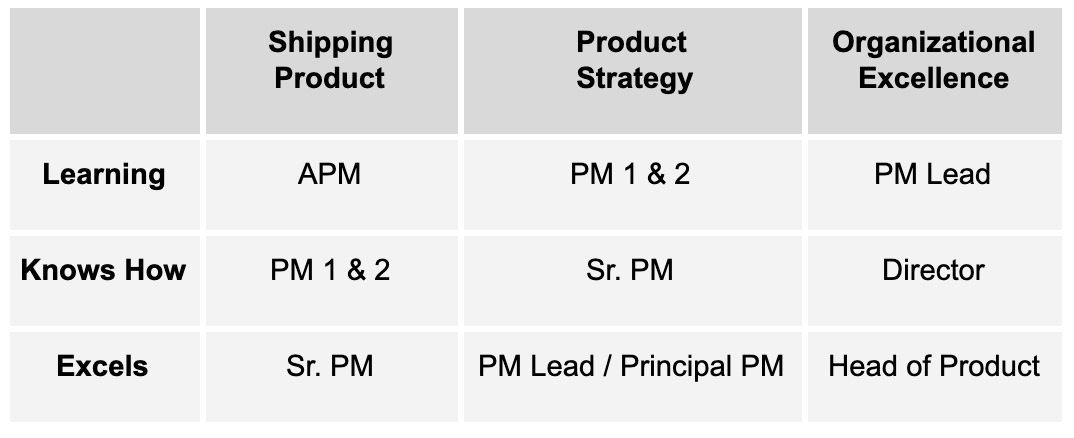
Lets make that more concrete.
Hiring for junior roles
They want someone who can get the job done. People eager, hardworking, and coachable. Someone with the potential to earn trust and and grow over time.
Hiring for senior roles
They want someone who can be trusted to run independently. People who already know how to set strategy and deliver great results without much hand-holding. Someone who shows good judgement.
Hiring for director+
They’re looking for leadership in both senses of the word: someone who can run an organization AND elevate the leadership team they’re a part of. Someone who thinks company-first, builds high-performing teams, and contributes to organizational excellence—not just their own team’s output.
So how do you assess that in an interview?
Behavioral questions are less likely to have an official rubric. The hiring manager trusts their gut.
Luckily, that gut intuition has some basis. Let’s break it down.
Junior level
They’re hired for potential. The question is: do they show hunger, humility, and enough relevant experience?
✅ Led a project from beginning through launch. Can be side project or non-tech.
✅ Shows basic values for the role (eg. customer focus for PM, usability for design)
✅ Willing to work hard and see things through
✅ Enthusiastic to learn
No-hire signals for people with relevant experience tend to be about attitude and mindset: lack of effort, lack of curiosity, big ego. For product managers, I’m mostly checking for Product Mindset, to make sure I’m not hiring a project manager.
Senior level
Regardless of your title, senior-level people are hired for trusted, strategic ownership. Here’s what good looks like.
The project
✅ Identified & prioritized an opportunity (vs. being assigned it)
✅ Results were successful and impactful (and connected to company strategy)
Decision-making
✅ Grappled with tradeoffs, considered the pros and cons of each side.
✅ Saw the merit in other people’s points of view and addressed or incorporated their feedback.
✅ Made good decisions using their bigger picture expertise and judgement.
Ownership
✅ They were the expert.
✅ Skillfully influenced other people to get their direction supported, even over pushback
✅ They didn’t hide behind leadership—they owned the constraints and goals.
Weak answers often sound… passive. Like someone who’s done good work, but mostly followed the plan.
They didn’t ask questions, work through tradeoffs. They seem shortsighted, weighing factors incorrectly, missing better solutions. They brushed off feedback or blindly followed it.
Director+
The bar shifts again. You still need all the senior-level behaviors—but layered with organizational excellence.
Trusted leadership:
✅ Take a company-centric strategic perspective.
✅ Built trust and deep relationships across the company.
✅ Conveys confidence by being a real expert in their area
Operational excellence:
✅ Has a robust philosophy for the different aspects of building and running a high performing team.
✅ Communicates a strategic vision for their team.
✅ Delivered scalable impact through their reports — more than a few star ICs could.
Bad candidates sound like they’re new to the leadership role. They’re not conveying “been there, done that.” They identify more with the team of people they lead than the broader company they serve.
What about Values and Strengths
Seniority is just one axis. Strengths and values are another.
Questions like “Tell me about a time you had to make a decision without data,” or “Tell me about a conflict” are probably probing for specific values and strengths.
The list of values and strengths is too long for you to cover them all in a single story:
Expertise in a specific technology, industry, or tool
Team player / good collaboration
Execution / project management / overcoming obstacles
Product / design skills (user centered design, data oriented…)
Move fast / scrappy
Craftsmanship
Curious / intellectually humble
Mission driven
Self-aware / coachable
and the list goes on…
Luckily, you can do your research. Amazon is famous for their Leadership Principles, OpenAI lists their values including Humanity first and Feel the AGI.
Reflect on the kind of PM you are. What values and strengths do you think are critical to your success? Highlight those in your stories.
The 3-point rubric most interviewers use (even if they don’t say it out loud):
Poor - the opposite of what we’re looking for
Acceptable - you might be good at this, but I’m not sure
Excellent - I’m confident you’ll always show this strength, even when it’s difficult
Failure:
“Oh yeah they wanted me to make a decision without data but I’m always data oriented so I had our user research team run a survey anyway.”
Excellent:
“Over the years I’ve learned that waiting for data can be a crutch. I’ve really adopted Amazon’s type 1 vs type 2 decision making approach. In this case it would be easy to measure if the solution was working, and easy to iterate if wasn’t”
Acceptable:
“We usually run A/B tests on changes to the invite flow, but in this case we knew we needed to make the change for accessibility reasons and we had user research that indicated it would be fine, so we went ahead.”
Conclusion
Hopefully this demystifies behavioral interview questions a bit.
To recap, depending on the level you’re interviewing for, you’ll need to show different skills
Junior: Relevant experience, role-specific values, willing to work hard, enthusiastic to learn
Senior: Identify an important strategic opportunity and deliver impactful results, Make good, reasoned decisions using senior-level expertise, Take responsibility for all aspects of the project, from influencing others to owning the constraints.
Director+: Be a valuable, respected member of the leadership team, Drive scalable results through a principled approach.
Consider whether your past interview answers have demonstrated these strengths. Look back at 4 mock interviews and see if you’d grade them any differently today. For more practice, try grading the gpt PM Interview Candidate.
Good luck!
If you’d like to read more, I’ve written before about what it takes to show seniority on the job: Becoming a senior Product Manager - Lenny’s Newsletter.
Excellent article, Jackie. I especially love how you've broken down the expectations by seniority. Very relatable.
I had a few questions that I hear from my network:
1. Theres a strong focus on comfort with AI in interviews these days. But many PMs are still making that transition and haven't had real world opportunities to prove themselves. Some are still in the process of upskilling themselves. How can seasoned candidates stand out in Senior PM processes where expectations around AI literacy and tool usage is so high?
2. As a hiring manager, how do you differentiate between made-up feel-good stories and genuine experiences?